
AESCHYLUS - ORESTES AND THE FURIES
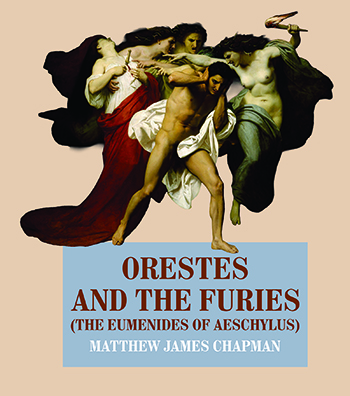
A PLAY THAT OPENS LIKE A HORROR MOVIE AND ENDS LIKE BEETHOVEN’S NINTH SYMPHONY . . . A LOST TRANSLATION OF A SUBLIME GREEK DRAMA.
ORESTES AND THE FURIES (THE EUMENIDES), by Aeschylus. Translated by Matthew James Chapman. With an Introductory Essay by Brett Rutherford. Why another translation of The Eumenides, and why now? The drama by Aeschylus, here re-titled Orestes and the Furies, is the final part of The Oresteia trilogy. It has elements of a civic pageant, set in Athens and for the common good of its citizens. It is a work of healing, placing a terminus on a primitive world of blood feuds, vendettas, and retributions; and, by extension, a work of grace and forgiveness that extends to all class and ethnic divisions that generate historic resentments. It seems a fitting time to revisit Aeschylus. This overlooked British translation, from the cusp of the Victorian era, demonstrates the power this drama radiated well past the peak of the Romantic era, the long, long afterglow of “the glory that was Greece.”
In his contribution to Western drama, and in his originality and power of authorship, Aeschylus ranks with Shakespeare. His innovations helped move Greek drama from solemn or festive pageantry to a genuine theater with individualized characters, and an emotional impact that led the Greeks themselves to conceive the concept of The Sublime. … The drama offers up a vengeful ghost, a sisterhood of powerful Furies who can bring famine and pestilence as well as individual retribution, and no fewer than three Olympian gods. The horrified Pythoness, and the jury of ordinary citizens, provide a human touch.
Most important of all is the binding spell that Athena casts, not only over the Furies, but in the pact she reinforces between the citizens of Athens and their guardian spirits. It is a civic covenant, and a lesson for our own times, the aftermath of our own national crimes.
Matthew James Chapman (1796-1865) was a member of that class of professional men who never gave up their school-boy passion for the classics, and who would dash off manuscripts now and then to friendly editors. Blackwood’s Edinburgh Magazine published his translation of Aeschylus’s Prometheus Bound in 1836, followed by his first draft of The Eumenides in 1837. A translation of Euripides’ Alcestis followed in 1838, and then, a year later, the same magazine’s editors found Chapman’s 1839 revision of The Eumenides worthy of their pages. That second version is the basis of the present text. It has never before appeared in book form.
Published June 2026. This is the 401st publication of The Poet’s Press. A Yogh & Thorn Books/Poet's Press edition. Paperback 8.5 x 8.5 inches, 78 pages, illustrated in full color. ISBN 9798199732031. $18.95. Kindle EPUB edition for $3.99. CLICK HERE to order from Amazon.
To order PDF and EPUB3 ebooks for $2.99 from The Poet's Press Online Bookstore, CLICK BELOW.
Version 1.1. Updated June 09, 2026.